Tag Archives: February 2010

Troy, it’s real

Chris in front of the Trojan Horse from Brad Pitts movie, Troy. It is the closest Chris or I will ever be to Brad Pitt. This monu­mental horse is found in Canakkale, Turkey.

On the way to the site the clouds didn’t hold much hope for us as they blocked the sky and quickly made puddles in the street. The dolmus con­tin­ued to bump and turn on the winding streets. Some other tour­ists spoke loudy in the front. We couldn’t under­stand them. We only knew it was taxing to be forced to listen.

The  clouds parted just as the dolmus stopped at the long walkway leading up the site of Troy. Wonderful, we thought.

30.00 Turkish Lira ($20.00  CAN) later we found ourselves stand­ing at the base of another wooden horse. Unfortunately Brad Pitt never touched this one, but you can go inside! So of course being  me, I did. Chris on the other hand decided to climb the walls of Troy.

Chris climb­ing one of the major walls at Troy. Don’t worry this is as high as he went. The site is located 30-minutes away from Canakkale, Turkey.

For us, the road to Troy started at the Archaeological Museum in Istanbul. The museum con­tains arte­facts from archae­olo­gical digs from all over Turkey. Almost one entire wing is ded­ic­ated to the arte­facts found at Troy. The col­lec­tion is sorted and dis­played depend­ing upon which Troy it came from.  The site was actu­ally inhab­ited many times, leading to a suc­ces­sion of seven sites built on top of each other. Like most archae­olo­gical sites, not much remains except for the stone found­a­tions of build­ings and remaints of for­ti­fy­ing walls. The site has been excav­ated of all its treas­ures which are now housed in dif­fer­ent coun­tries. However, a very com­pre­hens­ive col­lec­tion of pottery, tools and elab­or­ate jew­el­ley can be seen at the Archaeological Museum in Istanbul. Many of the items on display were found by Heinrich Schliemann, oth­er­wise known as the Father of Archaeology.

I found this human­ized vase very amusing. Found in the Archaeological Museum in Istanbul.

According to the descrip­tion of this arte­fact, this vase resembles a woman. I love the life and play­ful­ness of it. Found in the Archaeological Museum in Istanbul.

Ear rings that resemble the ones worn by Heinrich Schliemann’s wife in pho­to­graphs. Found in the Archaeological Museum in Istanbul.

The gold work of Troy, found by Schliemann. Found in the Archaeological Museum in Istanbul.

Unfortunately, being the Father of Archaeology doesn’t mean he had the perfect tech­nique. It simply means that he was the first person who wasn’t purly a treas­ure hunter, but who actu­ally had some curi­ous­ity and interest in the place, the people and the history.

We met a tourist who firmly believed seeing the site of Troy wasn’t worth it because it was just a pile of rocks and that there isn’t much there anyway. I find this atti­tude and state­ment can easily be applied to most, if not all, of the ancient sites in Turkey. Not only were rocks an ancient build­ing mater­ial, they still are today and if you dig a hole in the soil you will get 85% rock. Rocks are every­where (just like cats and roost­ers). It’s not about the rocks. It’s what people did with the rocks and how the rocks explain the human story. I won’t deny that vis­it­ing site after site takes more patience and energy each time. It becomes harder and harder to imagine the theatre burst­ing with enter­tain­ment or the house walls con­tinu­ing to show elab­or­ate frescos pro­tec­ted by a wood roof.  I think about the time and effort of the people who built it, who depended on it day after day. It’s the least I can do. When I was younger I never liked history. I think it was because I never ima­gined the people, doing every­day tasks and having human emo­tions. As a young teen­ager history meant mem­or­iz­ing dates, timelines and names. History didn’t have a heart or per­son­al­ity. It was like looking at a rock and expect­ing it to do some­thing, instead of looking at the rock in rela­tion to the objects around it and the place­ment of the rock. But alas, enough of my rock meta­phor of history.

The very famous ramp found at Troy. This would have been the main gateway into the city. Imagine the walls con­tinu­ing upward with huge wood doors and to the left of the gate, a tem­por­ary store con­struc­ted out of cloth and wood.

Look for the ramp and walls in this diagram and then examine the photo of what is actu­ally left today.

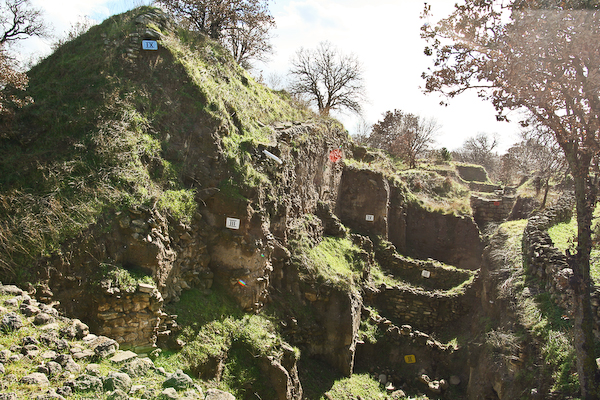
Here you can see the outer wall and in the upper left-hand side of the photo, the found­a­tions of a gate.

This diagram shows the com­plex­ity of the site. You can clearly see how one city was built on top of the last. Look closely for the Roman numer­als assigned to the dif­fer­ent layers. Then, look at the next photo of the actual site. Having a degree in Archaeology, and knowing a little about excav­a­tions, I don’t envy those who were respons­ible for ana­lyz­ing it, espe­cially with the mag­nitude of its world fame.

An excel­lent rep­res­ent­a­tion of the com­plex­ity of excav­at­ing the site of Troy.

After two hours with Troy prac­tic­ally to our selves Chris and I made our way back to Canakkale on the bumpy dolmus. It wove in and out of small towns, roost­ers and olive trees. Looking back over my shoulder I tried depar­ately to get one last glimps of the site. It quickly dis­ap­pe­arred behind the suround­ing hills. All that I could spot was the  reflex­tion of the six clean, white 52-passenger Turkish tourist buses. Perfect timimg, I thought.

For those of you who haven’t been, Troy is worth vis­it­ing — if you don’t mind inter­pret­ing the rocks.

This entry was posted in Turkey and tagged , , , , , , , , on by .

Feeling Fantastic in Fethiye

Ciao tutti! We haven’t had inter­net access for the past few days.  But alas, now that we are in our 30.00 Turkish Lira room per night ($21.75 Canadian) which has a lovely view of the Fethiye harbour, we couldn’t be happier.

The view from our cheap ($21.75 Canadian/night) room in Fethiye. We couldn’t ask for more, except for some beer to com­pli­ment the lovely sunset. A skip and a jump down the street was a store where we easily acquired some Efes (THE beer for Turkey).

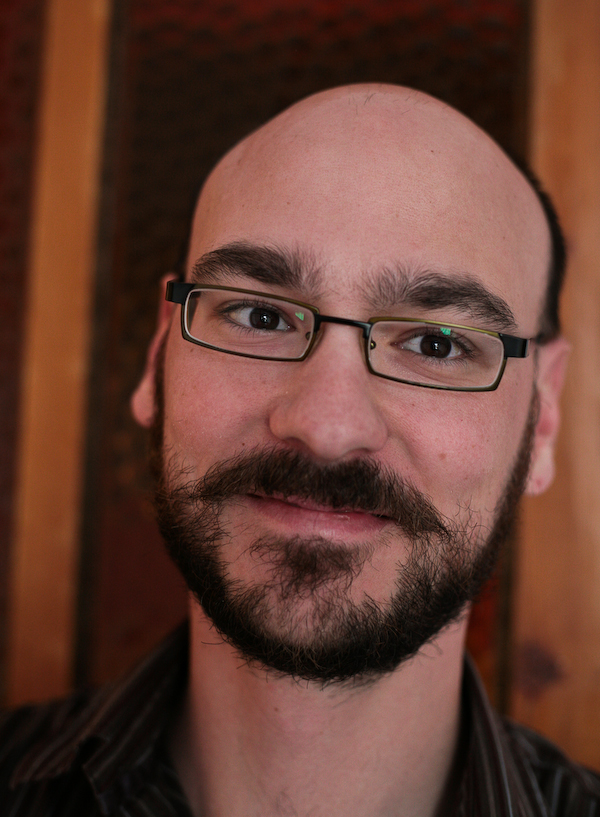
The town is bust­ling and the moun­tains and water are so peace­ful. Chris is in the process of shaving off most of his beard while I update you guys. I’ve got to admit, I’m excited. Ok, just for kicks, here’s a before shot of Chris with the beard he’s been growing since late December. He even grew out his hair! It’s longer than I’ve ever seen it.

The hand­some bearded Chris. Course I think he’s hand­some no matter what.

Once we’re both showered I think it’s date night on this gor­geous Friday evening. While we’re here, we have lots to update you on like the monu­ments at Ephesus, eating boar tongue for break­fast, our fab­ulous new friends Petrit and Gloria who we met in Selcuk, homemade dinner and drinks with friends from around the world (Australia, Italy, Turkey and Canada) and the unfor­get­table hike we did with Petrit and Gloria through a Turkish National Park where we came down the wrong side of the moun­tain and ended up 50 kilo­met­ers from our hotel. Lastly, check out the map, Chris updated it.

This entry was posted in Turkey and tagged , , , on by .

Another several hundred kilometers through Turkey... with pictures!

While Laura has been blog­ging her socks off, I haven’t gotten around to putting much up in a while. So here goes: a photo update on where we are and what we’ve been up to.

Broadly speak­ing, we are making our way down the Aegean coast of Turkey. We ducked inland at places like Bergama and Pamukkale, but will be staying closer to the coast in the next few days (weeks?) as we head around the south­east­ern corner of the country and con­tinue along the Mediterranean coast, before going inland again to visit Cappadocia and Eastern Turkey.

Bergama (site of ancient Pergamon)

We hiked 5km uphill to the akropolis of Pergamon. This was one of the views that rewar­ded us near the top. The ancient ruins are dra­mat­ic­ally perched on the top of a moun­tain over­look­ing modern Bergama. We enjoyed the ruins and the modern city very much.

The gravity-defying theatre at Pergamon, with modern Bergama far below. You can see our hotel if you look closely. It’s the one with the red chimney... Okay, no you can’t. But still, it’s down there somewhere.

The neigh­bour­hood we stayed in was a maze of streets like this one. It was charm­ing, if a bit con­fus­ing to navigate.

Another street scene in Bergama.

And another. This time with Bonus Old Lady!

Pamukkale and Hierapolis

Pamukkale was like a bit of vaca­tion from our vaca­tion, as it were. Hot springs, walks in the Turkish agri­cul­tural heart­land, being chased by an enorm­ous barking sheepdog–with his taut muscles, big teeth, and eyes like  a rabid were­wolf. Yeah, it was bliss.

Laura dips her feet at Pamukkale. We ducked inland to visit this site, where Roman ruins lie at the top of a mag­ni­fi­cent ridge covered in built-up calcium depos­its from thou­sands of years of natural hot spring activ­ity. Yeah, it was as nice as it sounds.

One of the travertine pools on the Pamukkale ridge. Pamukkale trans­lates as “cotton castle,” for reasons too obvious too explain.

The “Antique Pool” among the Hierapolis ruins of Pamukkale. Although it cost us about $15 CDN on top of the $15 we paid to get into the site, we had to swim in the nat­ur­ally warm waters of the pool among the sub­merged stones and columns. These col­lapsed into the waters due to an earth­quake about 1300 years ago (if I’m remem­ber­ing cor­rectly). Because we are trav­el­ing in the off-season, we had the pool to ourselves for a bit.

Laura dips her feet, AGAIN. Sheesh. She’s always taking breaks. The water was a pleas­ant 30 degrees or so. It was magic.

Some couple enjoys the view from the theatre at Hierapolis, above of the white travertine ridge. I like this shot.

We saw some tombs over­look­ing the valley. This one was the first mound tomb I’ve ever been in. Spooooky!

Tombs down low. Tombs up high. There were tombs all over the place. I think I may have more to say about tombs in another post.

The next day, we struck off blindly into the Turkish coun­tryside for a bit of a hike. We saw several flocks of sheep and their shep­herds. As we were walking through the barren scrub, we sud­denly crossed a line and were in green, irrig­ated grass. I turned around and shot this in the dir­ec­tion from which we came.

I’m no Ansel Adams, but here’s another black and white land­scape from our walk. For the photo nerds: the vign­et­ting is from stack­ing an ND8 filter with my CPL.

Another land­scape from that day. Believe it or not, these are all sep­ar­ate olive trees.

I’ve never been the greatest land­scape pho­to­grapher but I hope to get better. We found this cairn at the top of a long, gently sloping farmer’s field. We spec­u­lated whether it marks someone’s grave. I think it prob­ably does. From here, we could see all the way across the valley, some 60 to 100km away. I can think of worse places to be buried.

Afrodisias

We took a daytrip from Pamukkale to visit an ancient city called Afrodisias. Named after the (Greek?) goddess of love, Aphrodite, the place holds the remains of a once great temple where all sorts of sordid orgies and whatnot went on. All in the name of reli­gion, of course. The Christians con­ver­ted it into a church in the first mil­len­nium some­time, and must have had a few sleep­less nights puri­fy­ing the place. Anyway, I’ll let Laura put up some of her pics from there of the ruins and whatnot. I was more inter­ested in taking pic­tures of things like frogs and trees apparently.

In all honesty though, you can only find ancient ruins pho­to­graph­ic­ally inspir­ing for so long. Eventually they all start to blend together a bit. It is much more inter­est­ing to put the camera down and instead try to imagine what the place may have been like in ancient times.

We found these frogs in the flooded bottom of the Odeon. There were dozens of them swim­ming among the maple leaves.

Dozens, I say!

Another Ansel Adams wannabe shot.

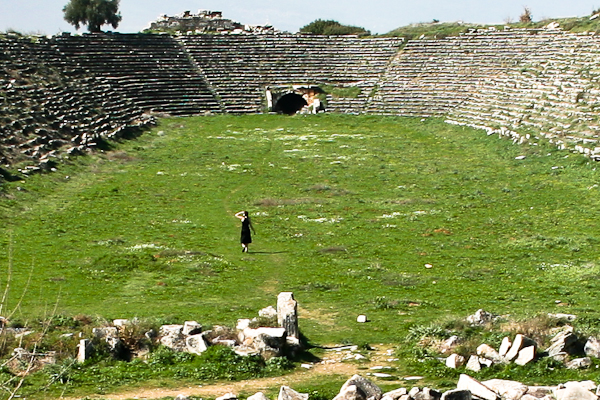
And one last ancient ruin: The stadium of Afrodisias is cer­tainly one of the best pre­served Roman sta­di­ums in the world. This thing is HUGE. Laura is the tiny black spec you can see just to the left of centre in the open green space.

Here’s a crop of the last picture to show you I’m not joking. The place is huge. Like, ‘it-could-seat-80,000-people’ huge. By the way, they held gla­di­ator games here. Men and beasts com­peted on the field of battle for the glory and esteem of the people. Or maybe it was just grue­some enter­tain­ment. Either way, it was pretty badass.

That’s all for now. See you next time! We finally have enough exper­i­ence (and photos) to put up a post about Turkish food. Mmmmmm.

(Also, we like com­ments. It’s really easy, just click below.)

This entry was posted in Turkey and tagged , , , , , on by .

Gallipoli Battlefields

Every April 25 thou­sands of people par­ti­cip­ate in a memorial service for those who fought at Gallipoli with Anzac. At this par­tic­u­lar loc­a­tion roughly 4,000 seats are set up for the ceremony.

If you were to turn around from facing the ocean and the Anzac sign you would see this land­scape. To the left of Chris is a rock form­a­tion the Australians nick­named the Sphinx because it some­what resembled the Sphinx in Egypt where the men trained prior to their arrival in Turkey.

This is Anzac cove which at the time of the attack during the First World War was not known as that, but since then the Turkish gov­ern­ment offi­cially changed the name to honour the sol­diers and the nine month battle. Today there is a road cutting through the middle of the hill thou­sands of Australians scrambled up in hopes of secur­ing the high points of the Gallipoli area.

This is one of the many Commonwealth War Grave cemeter­ies in Gallipoli National Historic Park for the sol­diers of Anzac. I was sur­prised to find the head­stones are a dif­fer­ent shape than all the other Commonwealth War Cemeteries I have visited in Canada, France, Belgium and the Netherlands. I am not sure why they are different.

In some areas of the bat­tle­field the Anzac and Turkish trenches were only nine meters apart. One day, around this area, an Anzac soldier was wounded. He started yelling for help. He kept yelling. Neither side wanted to risk leaving his trench in fear of getting shot. Hours passed. The wounded soldier kept yelling. Then a Turkish soldier climbed out from the safety of his trench. He picked up the wounded man and carried him to the Anzac side before return­ing back to the Turkish side. Miraculously no one fired at the Turk. In a battle where mil­lions of bullets were shot, so many that in the Gallipoli museum you can see two bullets that hit each other in the air, it is truly amazing that the two men com­mem­or­ated in this statue were not hit. The pos­sib­il­ity of two bullets hitting each other in the air is about a 1 in 160 million chance. It happened more than once. I see this Turkish mans actions as one of the rare occa­sions of what human kind could be, but unfor­tu­nately we are creatures who will never live without war.

The entrance to the the largest Turkish memorial and cemetery in the part of the Gallipoli National Park that we toured. It was very inter­est­ing to see the dif­fer­ence of the Turkish cemetery com­pared to Commonwealth War Grave cemeter­ies. The stone used to con­struct the memorial and walls is yellow painted cider blocks, the head­stones are flat, and there is an out door prayer area with provided prayer rugs.

Each Turkish sol­diers head­stone in the First World War Gallipoli cemetery has the symbol of a cresent moon which sym­bol­izes life, and the symbol of a star which sym­bol­izes death. Together they sym­bol­ize that life will con­tinue. The same symbols are fea­tured on Turkeys flag. The head­stone of the Turkish sol­diers has the name of the town he was born, his first name, his fathers first name, the year he was born and the age he died. This par­tic­u­lar soldier was from Gallipoli. His first name was Ismah. The “oglu” means, “son of”. His father’s first name was Ahmet. “Dogum”, means “born in”, and “Yasinda” means “years old”. Before 1934 Turkish people did not have sir names. This is why we only find the first name of the soldier and the first name of his father. This makes it incred­ibly hard for people today to find the graves of their rel­at­ive. Standing in one spot in the cemetery our guide pointed to five graves of dif­fer­ent sol­diers all with the same first name, Mehmet. Imagine if more than one of them was from the same city or town and around the same age.

This statue is of the oldest First World War Turkish veteran and his great-great-granddaughter. According to Turkish belief, if you see your great-great-grandchild you are going straight to heaven. He was 110 years old when he passed away. When he was 109 years old he came to the Turkish memorial and cemetery to unveil this statue of himself.

This grave belongs to young man named John who climbed up and down the rugged hills with his trusty mule, during the Gallipoli battle, retriev­ing wounded or killed sol­diers. With the help of his mule he saved the lives of some 300 sol­diers. All the sol­diers new about him weather they were allied sol­diers or Turkish sol­diers. One day, on May 19, 1915, some new Turkish recruits were on duty for their first time in the Gallipoli area. They saw John and his mule. Recognizing him as the enemy, they shot him. They didn’t know the story about John like all the seasoned vet­er­ans of the Gallipoli battlefield.

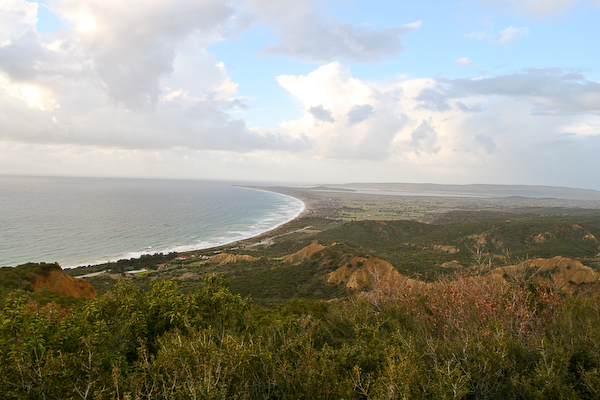
The view of the Aegean Sea from the First World War site, the Nek, one of the highest points in Gallipoli National Park.

This statue of Mustafa Kemal, more widely known as Ataturk, was erected beside the Commonwealth memorial on the highest point of the Gallipoli bat­tle­fields. Mustafa Kemal was the divi­sional com­mander for the Turks. Under his command, the Gallipoli battle which went from near dis­aster to una­quivical success. Following the war Mustafa Kemal traveled through­out Turkey gaining the support of the people and earning the name, Ataturk. Today, in every town, city, build­ing, res­taur­ant, hotel and park you can be sure to find either a statue or photo of Ataturk. One day on the bat­tle­field while Ataturk stood prob­ably very much like he is in the statue, bin­ocu­lars around his neck, he was shot. Luckily the bullet was stopped by his pocket watch. On the statue you can make out the faint shape of a pocket watch in his breast pocket. Today Ataturk’s pocket watch can be found in Berlin, because as a plea for help he mailed it to the German com­mand­ing officer as a visual of the des­per­ate times they were in.

This entry was posted in Turkey and tagged , , , , on by .

Topkapi Palace (Topkapi Sarayi)

The second gate into Topkapi Palace. Today it is the main admis­sion gate into the museum.

Topkapi Palace located in Istanbul, was the headquar­ters for the Ottamen Empire for more then 400 years. Today it is a museum. When we went it cost 20 Turkish Lira per person, and if we wanted to go into the Harem it would cost an addi­tional 15 Turkish Lira per person. The ticket for enter­ing the Harem has to be bought once you are inside the Topkapi Palace.

The palace is con­struc­ted around a series of court­yards, all of which are very beau­ti­ful and peace­ful. The first court­yard is free of charge. In Ottoman days this court­yard was open to all, but in order to walk through the gate into the second court­yard you had to be some sort of dig­nit­ary (see the photo above of the second gate).

Only the sultan and his family could enter this gate. Through it were the private (i.e. cir­cum­cision room) and res­id­en­tial areas of the palace. The gate was used for special cere­mon­ies, acces­sion and to perform the funeral service of the sultan. Today tour­ists flock through it and attempt to take photos of kittens in front of it, like our infam­ous Chris, center stage.

Within this court­yard for dig­nit­ar­ies and offi­cials is the courtroom where the men took care of the Empires offi­cial matters. Apparently the sultan use to sit behind a mesh screen and listen to the dis­cus­sions and debates, pre­tend­ing as if he was a fly on the wall and no one knew of his pres­ence. However, it was known for him to some­times speak up and com­pletely over­rule the decision of all those in the room. I found it quite comical to imagine it happening.

The gold, mesh rect­angle in the center of this photo is the screen behind which the sultan would secretly listen to the dis­cus­sions and debates of the Ottoman Empires officials.

aOne of the many detailed designs found on the ceiling of a room in Topkapi Palace.

The atten­tion to detail in Topkapi Palace is remarkable.

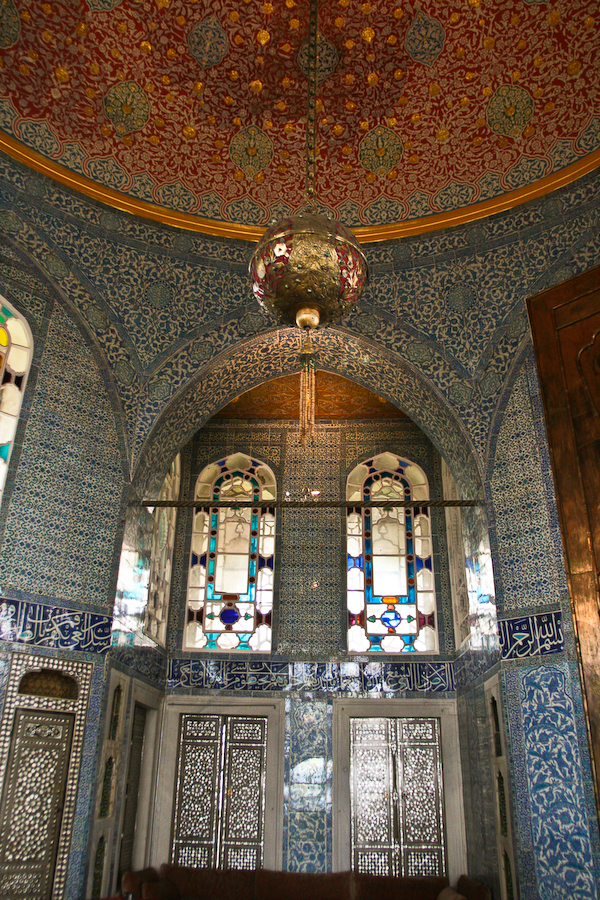
This is the interior of a build­ing called the Baghdad Kiosk, located in the res­id­en­tial area of the sultan. It is an excel­lent example of the famous blue Iznik tiles and mother-of-pearl inlay found through­out Ottoman archi­tec­ture in Turkey.

The most mag­ni­fi­cent things housed in Topkapi Palace are the jewels, like the worlds fifth largest diamond which was ori­gin­ally traded for three spoons giving it the nick­name, Spoonmaker’s Diamond. The col­lec­tion also has some of the worlds largest and most pristine emer­alds found on the Topkapi Dagger which had a movie (1964) made about it called, Topkapi. But, as you can imagine, we were not aloud to take photos of such pre­cious items.

This entry was posted in Turkey and tagged , , , , , , on by .