Tag Archives: May 2010

Photos from our two day Madrid adventure

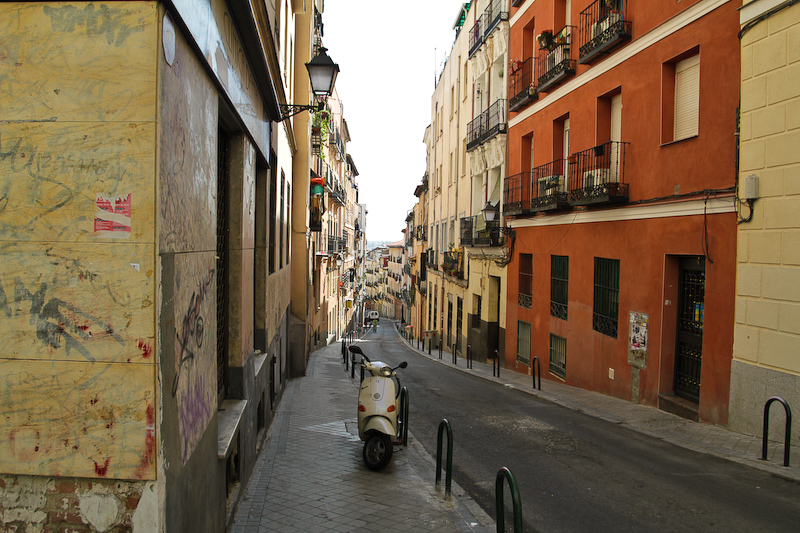
A lovely Madrid street.

In many of the res­taur­ants and pubs you’ll see a pig leg in a vice to make it easier for staff to cut off thin slices. Um. Yummy.

I enjoyed this drink on our tapas tour. It is kind of like sangria. It is wine with Sprite and a couple pieces of fruit, like lemons, thrown on top. It’s deli­cious and refresh­ing in summer heat.

On our second (and last) day in Madrid we decided to go on a tapas tour. Tapas are tra­di­tion­ally the little snacks you are served when you order a drink.  They are called tapas because back in the day the small plate of snacks would be placed on top of the drink you ordered.  On our tapas tour we were taken to three dif­fer­ent bars where we got a small com­pli­ment­ary drink and a tapas or two.  The tour con­sisted of myself, Chris, the guide and a writer for “Let’s Go” travel books.  The writer named Grace was enjoy­ing her first week out of six in Spain.  She was a young 20-year old student from Harvard who managed to secure a gig for herself writing for “Let’s Go”.  She was kind enough to take down our blog address and appar­ently on her own “Let’s Go” travel blog will put a link to ours!

When we passed the royal palace in Madrid, it just so happened to be the chan­ging of the guard.

Laura enjoy­ing a “Churro”, which is a tra­di­tional Spanish desert. It is deep fried dough which you dip in melted chocolate.

Chris enjoy­ing his churro.

A HUGE cup of melted chocol­ate for our churros, and if that isn’t sweet enough the servers kindly placed two pack­ages of sugar on the plate.

We enjoyed eating a paella, another Spanish dish.

Paella in all its glory, eye-balls and all.

An ele­phant doing a trunk stand.

A ver­tical garden on a build­ing outside the (FREE) modern art museum located near the Prado Museum.

Chris relax­ing on a bench in Madrid’s largest public park, El Retiro. As you walk further into the trees and many path­ways the con­stant rumble of the traffic fades away and it’s hard to believe you’re in the middle of Madrid.

A flower Chris and I enjoyed in the Botanical garden (2.5 Euro/person) in Madrid.

The Sol Square in Madrid.

The Reina Sofia Museum which houses many paint­ings by famous artists like Goya, Salvador Dali and Picasso. This museum is a must-see if you visit Madrid. Free on Saturday after­noons (2.30pm-9pm), Sunday morn­ings (10am-2.30pm) and on Mondays, Wednesdays, Thursdays and Fridays from 7pm to 9pm.

This entry was posted in Spain and tagged , , , , , , , , , on by .

Moroccan ceramics, food, fashion, religion and most important, tips on how to use a squat toilet

Sahara Desert spider. This little guy crawled into our tent one night during our Sahara Trek. Our guide quickly killed it. After looking at the spider more closely, I was glad he did.

During our 3-week adven­ture in Morocco, I noticed some inter­est­ing things that I thought I could share with you.  Currently we are in Bucharest, Romania. We just arrived here yes­ter­day after a one day layover in Milano, Italy and before that we spent a quick two days in Madrid. I will get some photos up of Madrid shortly. In the mean time enjoy the following.

CERAMICS & TILES

Morocco has tiles on some roofs that strongly resemble the ones used in Italy, only the tiles are smaller and are usually found in one of three colours:  orangish-red, blue or green.  After vis­it­ing a ceramic pro­du­cing town near Zagora in south-eastern Morocco, we learnt that green is the most common and tra­di­tional colour for not only roof tiles but also any shape that can be made out of ceramic, like ash trays, serving plat­ters, plates, sugar bowls and the infam­ous Moroccan tanjine pot.  In fact, green is the colour of Islam.

The roof tiles in Morocco are very much like the ones in Italy. They are gen­er­ally green, but you’ll also see blue and an orangish-red.

The many dif­fer­ent colours of the ceram­ics are pro­duced with primar­ily natural dyes.  The yellow ceram­ics are dyed with saffron, the blue with indigo, and the light pinkish-red with henna water and lemon. The green is made from a com­bin­a­tion of three things, one of them being copper. Some ceram­ics are fired once to make them off-white in colour, then they are dec­or­ated with nat­ur­ally pro­duced henna.   After one more firing in the kiln, the design is everlasting.

FOOD

Lunch and dinner in Morocco start with com­pli­ment­ary bread and a small plate of fant­astic fresh olives.  Salt and pepper are kept in small, com­munal dishes on the table instead of shakers. This means every­one must use their fingers to pinch the salt and/or pepper onto their food.  The pure lack of soap, toilet paper, hand blowers and paper towels in restrooms has led me to eating my meals without the aid of salt and pepper.

A weekly market in one of the small towns of Morocco. If you’re hungry while shop­ping you can grab a roasted corn cob.

ALCOHOL

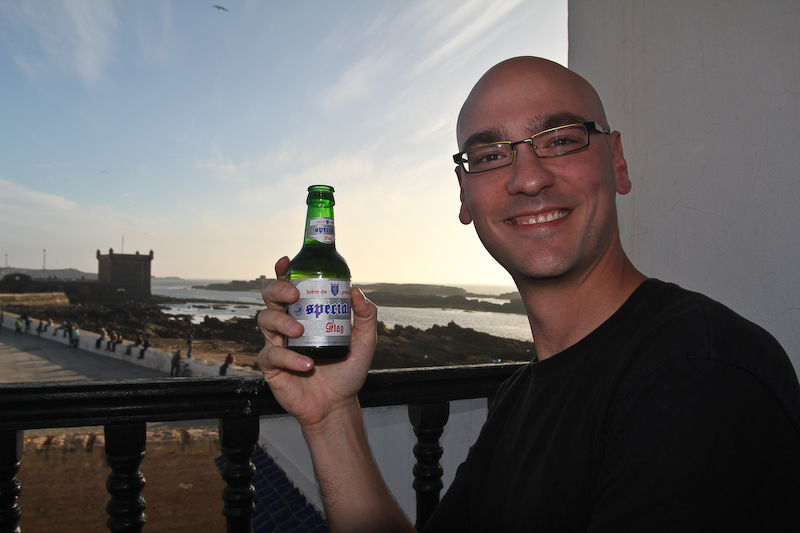
It is almost impossible to find alcohol in Morocco, although it is avail­able. The local brew is called “SPECIAL BEER”, that’s lit­er­ally and actu­ally the name of the beer.Chris enjoying Morocco's special brew of beer. It comes in itty-bitty 24 cl bottles. Roughly three of these bottles equates to one stand­ard Canadian bottle of beer.  The servers in one bar had a habit of leaving the empties on the table, there­fore making Chris and I look like extreme alco­hol­ics when we had accu­mu­lated 12 bottles on the table within a couple of hours.

MOSQUES

Islam is the main reli­gion in Morocco yet prayer call is not heard as often nor as loud as in Turkey. In fact, the call to prayer in El-Jadida sounded very dif­fer­ent. It sounded shorter and stac­cato. Mosques are not as plen­ti­ful or easy to locate.

A large mosque in Tangier’s medina over­look­ing the Strait of Gibraltar. You can just make out Spain in the distance.

The only indic­a­tion of a build­ing being a mosque is the 5–6 story square tower. There are no domed roofs, extra spires, or elab­or­ate dec­or­a­tions and tile work like the mosques of Turkey.  In a sense, the mosques had a much more humble feeling.

WOMEN’S CLOTHING

Young girls and adoles­cence wear western styled clothes like tight emo-jeans and T-shirt.  The major­ity of women and teenage girls wear head­scarves and occa­sion­ally you’ll see a girl as young as seven wearing one.  The women here must have huge ward­robes in order to have a head­scarf that per­fectly matches the long-sleeved shirt which she has to wear under the floor-length back­less summer dress. This is the attire of a very modern Moroccan lady in a big city like Meknes or Fes.

The tra­di­tional outfit of Moroccan women. It is worn over their normal clothes, like a jacket.

In nearly all the rural cities, towns and still within the larger cities the major­ity of women con­tinue to wear the tra­di­tional outfit, a long-sleeved, ankle-length, hooded, “jacket”.  Patterns and colours are limited only by the ima­gin­a­tion.  They come in pat­terns like leopard, zebra, bright red, green, purple, floral print, vibrant tur­quoise etc.

The tan­ner­ies in Fez’s medina souk. This is one of the first stages in cre­at­ing the many fash­ion­able bags or purses for sale. The entire area reeked of death (like Brooks Alberta).

MEN’S CLOTHING

The variety of mens dress exceeds any­thing yet seen in the history of the Western world. Primarily men just wear pants and collared T-shirts, but you will also see men in thobes (a long-sleeved, floor length, white col­oured outfit, which kind of looks like a dress shirt that’s been tailored to the ankles), a jacket some­what like the ladies only without the hood and slightly wider cut and lastly some men wear long-sleeved, floor length, hooded robes usually dark brown or green in colour.

A husband and wife stroll through the Eassouria medina souk together.

When men are dressed in these with the hood up they remind me of the Jwa’s from Star Wars.  The hoods are very unique in how they point at the top and how the men fold them up so they can see.

SHOES

Moroccan shoes.

This style of shoe is “very Moroccan”. All ages of people wear them.  It is almost as if the design of the shoe developed out of func­tion (like most things).  You know when you’re in a hurry to catch someone who just left your house, how you slip on your shoes really quickly flat­ten­ing the heals into the shoe?  The Moroccan shoe looks like this has happened to all of them, only the maker sewed down the heel in the squished down position.

TOILETS

Carry around soap in a plastic bag in your purse because 98% of toilets do not have any type of hand san­it­izer.  It is also wise to carry around hand san­it­izer to use before/after toilets and eating.   In Morocco , 95% of the toilets are squat toilets. If you are not use to these it helps to wear a skirt which can be easily lifted out of the way.

Squat toilets are every­where in Morocco.

To avoid as much spray back as pos­sible it is import­ant to put your feet at quite a wide stance, but even more import­ant is squat­ting as low as you can (without falling into the fes­ter­ing hole of waste beneath you!). My last piece of advice on how to squat prop­erly and come out rel­at­ively clean is aim. The better you are at aiming for the drain increases your chance of less spray back by ten.  Some squat toilets have a flush, some don’t. Look up and around for a string to flush. If you don’t see any­thing, I can guar­an­tee you’ll see a tap and a little bucket.  Without think­ing about it too much, turn on the tap, fill the bucket and dump it down the hole. This must be the most energy effi­cient flush on the planet, but now you see why I highly recom­mend car­ry­ing soap and hand san­it­izer. Toilet paper, very import­ant, is not used really in many places believe it or not.  Carry your own toilet paper at all times. Sometimes there will be a garbage bin with you and your squat toilet. If not, try to use as little as pos­sible and wash it down the drain with your little bucket. Do not put tampons down the toilets, you may really, really regret it.

This entry was posted in Morocco and tagged , , , , , , , on by .

Sahara Diaries, Part 6: The Lows and the Highs

May 16, 2010 — 7:30 pm

Forget everything I said before. This place is not romantic. It’s deadly, unfor­giv­ing, and miser­able. Full of pain and agony.

Do not come here. Do not let your loved ones come here.

Okay, maybe not that bad, but right now Laura and I are in low spirits. We’re tired. We ran out of mineral water, and can’t help but remem­ber how Rashid care­lessly drank some, and used some more for dishes and washing on our first day. Rashid can drink the well water, but we can’t for legit­im­ate fear that the bac­teria and microbes will make us sick. We’ve put some treat­ment pills in a bottle of well water, but have to wait two hours for them to do their work. We’re very thirsty, and have aches and pains through­out our bodies. Rashid said it would be an hour from our lunch spot, but it’s actu­ally been about three, and the heat is the harshest we have exper­i­enced. My little travel compass/thermometer maxed out today at an unbear­able 50 degrees Celsius.

We’re at Erg Chigaga as I write this, finally, but rather than feel proud or excited by this unique place, we feel hollow and taken advant­age of. The man in Zagora who sold us our camel trek, Mohammed, was very friendly, with a sin­cer­ity of laughter that bespoke of a straight-forward and honest busi­ness man. So when we asked him ques­tions about how long each leg of “the ride would be, and how long we would be “on the camels on any given stretch”, his answer of three to four hours sat­is­fied us. Yet here we are. It’s the end of our last day in the desert, we’re at Erg Chigaga, the great 40km expanse of dunes on the Algerian border, and we haven’t been on a damn camel once. We walked 60km through the Sahara Desert to get here, and we’re feeling too beat phys­ic­ally and men­tally to climb the great 300m dune that’s just right over there.

Shariff and Mimoun drudge on. We try to keep up.

Erg Chigaga stretches for about 40km, and is also only about 40km from Algeria.

The dunes of Erg Chigaga. “Erg” means dune.

Dunes and tam­ar­ist trees.

We asked after the camels again when we arived. Rashid’s response was the same as usual: apres, apres, “after, after.” This time we pushed him. “After what, Rashid? After we set up camp?”

Wahha, wahha,” he said. “Okay, okay.”

But then, before we knew it, he sent the camels off into the distant plain to feed. We can see them now, from where we sit atop a small dune. They’re at least 4km away and the light is failing fast. There’s no way we can muster the energy to get out to them, and no way Rashid can collect them before sun down. We simply can’t under­stand why he won’t let us ride them. Laura is very dis­ap­poin­ted and upset. I can’t blame her, either. She never rode a camel while she lived in Saudi Arabia. During  her one oppor­tun­ity she was too young and scared to give it a go, and her hopes of making up for it by spend­ing three days on one have been sunk. Riding a camel was one of her main goals coming to Morocco, and we thought we had it all but cinched when we booked our tour.

At this moment, right now, we are in one of the lows that make the highs of travel feel so amazing in com­par­ison. It sounds like a small thing, riding a camel, but after the beating heat and strain of walking 60km in the desert, that small thing is the whole world to us right now. We’re pissed off, frankly.

One of my goals on this trip, and in my life, is to “live without expect­a­tion,” what the Hindus call “relin­quish­ing the fruits of your labour.” While I can’t claim to be there yet, I am trying. But it’s not easy. This trip was not what we expec­ted. We’ve decided to take it up with Mohammed when we see him after. For now, I’m not sure my tired legs can even get me up one of the bigger dunes to watch the sun go down. My ankle is swollen like a base­ball and each step is agony.

Epilogue

That was my last entry in my journal from the dessert. It’s a sour note to end on, and one I’m happy to say didn’t last long. Within five minutes of that entry, we had purged the neg­at­iv­ity from our systems. Me, through writing it down, pretty much as you’ve just read it, and Laura through telling me how she was feeling and shed­ding a few stressed-out, tired, tears. We enjoyed a hug and felt some of the excite­ment and chal­lenge come back to us. Aching, dehyd­rated, tired to the bone, we egged each other on and raced up the dunes, toward the highest peak of Erg Chigaga. The sunset was coming on fast. We could see several other vis­it­ors sil­hou­et­ted at the top of one of the lesser dunes, watch­ing the sunset we had sought for four days through the desert. No doubt they had been brought out that after­noon in the rel­at­ive comfort of a 4WD, and the thought of them enjoy­ing what we had earned while we sat and moped buoyed us on further, until we were panting and gasping for breath as our tired legs carried us up one, then another of the big dunes. Soon we were on the ridge leading to the top of the biggest. The 4WD crowd were no doubt too lazy to bother climb­ing it, we told each other, laughing.

Good,” we declared. “We earned it. Those bas­tards couldn’t get through the desert. They prob­ably have air-conditioned tents down there.”

And although we made the top moments after the sun had dipped below the horizon, the effort had redeemed us. The sunset didn’t matter. Being here didn’t really matter, either. But the effort of just getting here did, camels or no camels. That last sprint redeemed us, and it redeemed a desert trek that will live with us always, stand­ing out among months of travel as some­thing unlike any­thing else we’ve ever done.

It also didn’t hurt that we ran into Mohammed that night. The next morning, Laura got her camel ride after all.

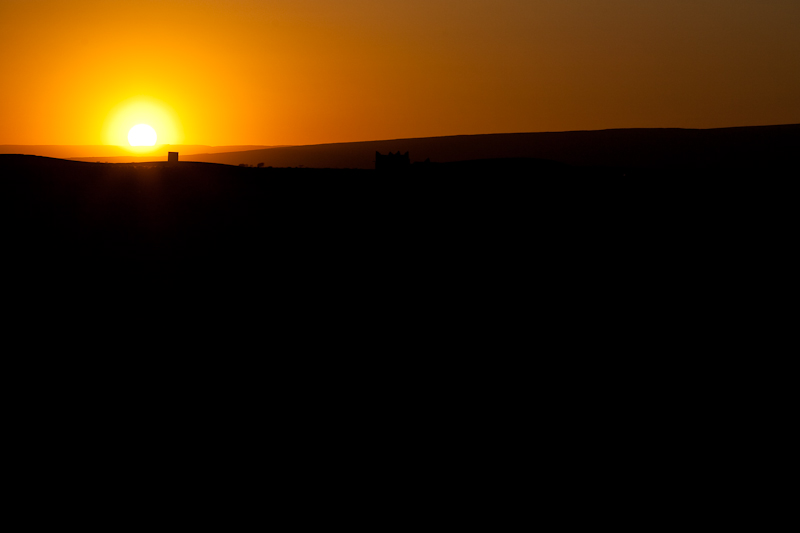
Sunset over Erg Chigaga. The bas­tards on the top of the dune likely got out here by 4WD. Bastards.

The view from the top. The sun had just set on us.

Laura chan­nels Arabian Nights.

Your intrepid blog­gers. Yes, it is that big. Bigger even.

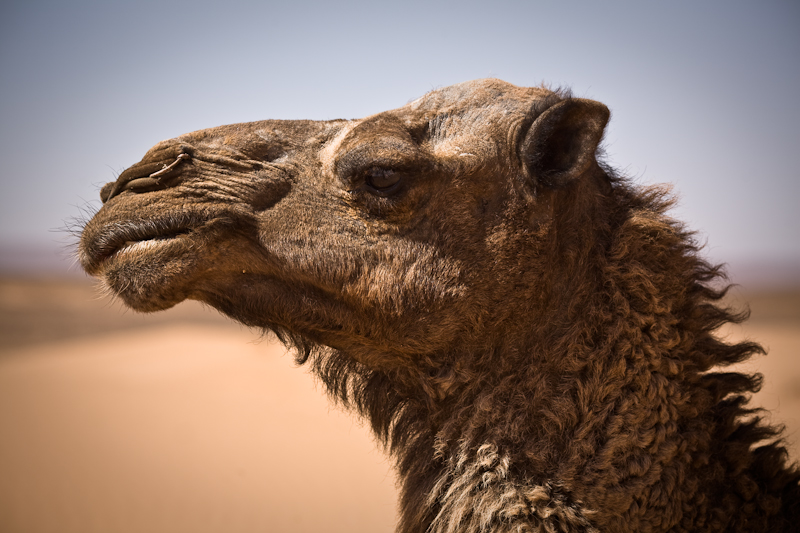
Camel rides, at last.

This is the final part of a six-part series on our camel trek in the Moroccoan Sahara. To read the full story, please click here.

This entry was posted in Morocco and tagged , , , , , , , , , , , , , , , , , on by .

Sahara Diaries, Part 5: Night of the Thousand Stars, Snakes, and other Deadly Encounters

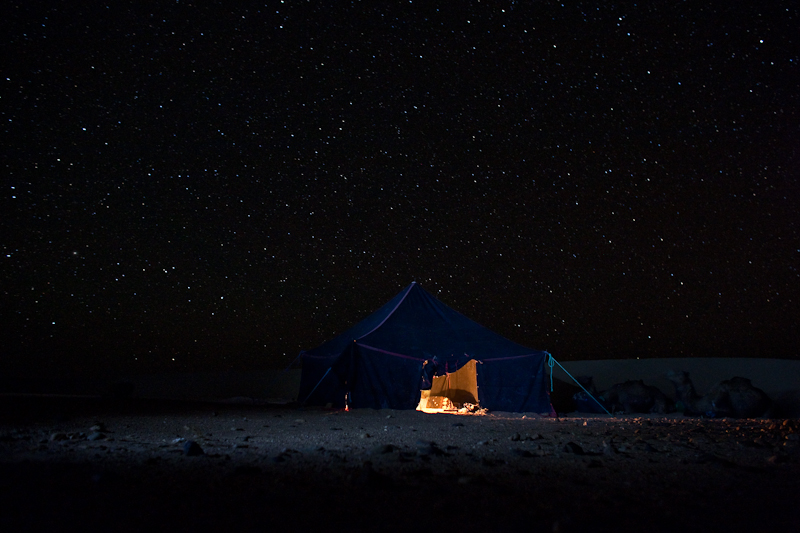
Some night pho­to­graphy. I “light painted” the tent with my LED flash­light. This was a 30 second exposure.

May 16, 2010 — Midday

The nights out here have been won­der­ful. Not only do we get to rest while things cool off con­sid­er­ably and Rashid sets to work on the evening meal, but we also get to enjoy the type of clear, starry sky you can only find in a dry envir­on­ment far from city lights, in the desert or the arctic. The company we paid to arrange this trek is called Caravane Mille Etoiles, the Caravan of the Thousand Stars, and the name is apt. The only thing they should work on is actu­ally telling people that it is not a camel ride into the desert so much as a relent­less death march in the baking sun.

The dunes them­selves have also been enjoy­able, even though we have only been camping among rel­at­ively small ones (maybe 50m tall). Burying one’s sore feet in the still-warm sand and watch­ing the sun set over a sea of dunes must be one of life’s great pleas­ures. The colours and tex­tures that come out of the sand are pre­dict­ably beau­ti­ful, although serious pho­to­graphy is all but impossible due to the heat, fatigue and just wanting to enjoy the last light of day without looking through a camera viewfinder.

Rashid’s kitchen.

Taking these things off is the best part of the day. Actually, we both switched from sandals to our hiking shoes after the first day or two. This is the view from our tent.

Sunset over the Sahara.

Yours truly. Photo by Laura.

Laura, int he best light of the day, right before sunset.

One of the other high­lights of our trek has been the array of desert life we’ve been lucky enough to come across. Of course living next to two huge, blun­der­ing camels has had its moments. Camels aren’t known for being shy about their bodily pro­cesses, pooping and peeing whenever and wherever the mood strikes them (includ­ing all over them­selves), and burping and farting as they spend the night just outside our airy tent. It’s like a desert sym­phony to offset the beauty of the starry sky.

Shariff and Mimoun are also natural garbeur­at­ors, eating any­thing put within reach of their search­ing camel lips. They’ll eat any­thing from food scraps like orange and melon peels (they like these a lot) to the scrub­bi­est thorn bushes in the desert. And that’s just break­fast. Shariff even ate Laura’s prized fos­sil­ized rock.

Our most common view of the camels.

These desert birds live in pretty much all of the tam­ar­ist trees.

But we’ve enjoyed other wild­life as well, includ­ing plenty of scarab beetles, red ants, a bur­row­ing owl, crows and small desert birds. This morning Laura spotted a dung beetle meth­od­ic­ally rolling his break­fast (one of Shariff’s ping-pong sized drop­pings) home for the wife and kids. We’ve also seen lizards and had fatal encoun­ters with a camel spider and snake. Thankfully, the encoun­ters were fatal for the spider and snake, not us.

Actually, the snake was prob­ably the most dan­ger­ous thing that has happened to us during the trek. Rashid was calm but stern after he spotted the snake on a nearby dune, not two minutes after leaving camp this morning. Laura and I went for our cameras as the snake slithered its way up a dune away from us, but if we went closer than about four meters, Rashid would say loudly, “Attencion! Attencion!”, motion­ing us back. When he snatched a tent pole and went after the creature, Laura and I both went into con­ser­vator mode, trying to tell Rashid that it wasn’t neces­sary to kill the thing, as the snake clearly only wanted to get away.

The Saharan Horned Viper.

But Rashid answered by hooking two fingers down­ward in the air with a quick hissing sound, in obvious imit­a­tion of snake fangs sinking into their prey. “Mort,” he said, simply. “Mort.

So we watched as Rashid deftly decap­it­ated the snake with one blow of the tent pole, fol­lowed by several more for good measure. After some prod­ding and our usual halted com­mu­nic­a­tion, we later learned from Rashid that this type of horned snake (he didn’t know the name in English, Arabic, Berber, or French) can kill a person with one bite. The venom is fatal every time, and the victim might only have one to three hours to live after a bite. (Update: After being spurred on by our friend Christine, who iden­ti­fied this beastie as a Saharan Horned Viper, or Cerastes Cerastes, I did a bit more research. The bite is not neces­sar­ily imme­di­ately fatal, but can lead to severe com­plic­a­tions if gone untreated. Don’t believe everything you hear in the desert, apparently.)

Believe me when I say, we were very much on the lookout for other snakes after that. We were also quite grate­ful to have been ignor­ant of this know­ledge during the first three and a half days of our trek.

This snake is deadly pois­on­ous. If you are bitten, you can count your hours left on one hand.

We have one more hot after­noon of walking to go. We feel better now after eating and a short nap. Rashid says it is only about an hour more. After lunch the desert always feels more romantic and excit­ing. Our energy levels are up and we ready to set out again.

This is just one part of a six-part series on our camel trek in the Moroccoan Sahara. To read the full story, please click here.

This entry was posted in Morocco and tagged , , , , , , , , , , , , , , , , on by .

Sahara Diaries, Part 4: Rashid, Pain, and More Pain

May 16, 2010 — Midday

No entry for yes­ter­day. Just too damned hot. Figured I’d make the effort today, despite my fatigue, before time and dis­tance dis­sip­ate my memor­ies like a camel fart in the desert.

Rashid. Guide, cook, keeper of the camels (keeping them away from us, at least).

I’m not a reli­gious man, but “prayer” is the closest thing to what was going through my mind as we struggled up and then crested each suc­cess­ive rise this morning only to dis­cover yet another scrubby valley to cross—prayer that each one would be the last, that we would finally see the dunes and scattered trees that might provide enough shade for our mid-day break. But valley after valley was the same baked hardpan. All we saw was more desert. Another shade­less expanse to cross. Another few kilo­met­ers before yet another rise and the hope that this might be it. We crossed about eight of these valleys this morning alone, and the tem­per­at­ure is above 40 degrees out here.

I have blisters and arch pain in my right foot, as well as growing swell­ing in the ankle (pos­sibly an old injury acting up). Laura is about the same, with blisters, sore knees, bites, and what she figures is heat rash on her legs.

Although it is day four of five, we still haven’t ridden the damn camels, and the black thoughts that run through my head as we lumber on, watch­ing Rashid and two camel asses get pro­gress­ively further away with our dwind­ling water supply strapped to their backs should not be repeated in polite company. Let’s just say I have con­sidered several of the ways a body could be dis­posed of in the desert.

Rashid and the camels.

This was prob­ably the most brutal section of the trek, with no shade or change in the rocky land­scape for at least 12 km.

This is what this place does to things. This is an old pack camel who died in one of the biv­ou­acs from disease. After it’s death, the owners brought it out to return to the desert.

Every step hurts, but we only have one more after­noon trek to reach the massive 300m dunes of Erg Chigaga, our final des­tin­a­tion. We’ll spend the night there, hope­fully after a camel ride of some sort. I’ve asked Rashid about the camels, as I know Laura is really looking forward to riding them, but his response is the same: “apres, apres.” He actu­ally seems to feign a bigger lan­guage barrier than usual whenever I bring up the camels. It’s odd.

The Tamarist trees in the dis­tance marked the end of one of the toughest stretches we faced, and were the answer to the prayer men­tioned above. They were a happy sight indeed.

Tomorrow morning we’ll be driven from Chigaga back to Zagora, after a couple of inter­est­ing stops along the way, and it will all be over. Of course, it’s not all pain and misery. Overall, Rashid has been a great guide, if a little stoic. I’m not sure if it’s just the lan­guage barrier holding him back, or if he’s just quiet, pre­fer­ring the solitude of his own thoughts to chatter. Of course, this is an ideal mindset for the desert, where even speak­ing, reach­ing for a water bottle, or bending over to pick up an inter­est­ing rock can require an iron will. The heat and exer­tion rob all thought and sap all extra energy. For me, retreat­ing into my own head has helped keep me focused on just taking the next step.

Of course, we’d be lost without Rashid, at least in a fig­ur­at­ive sense; actual nav­ig­a­tion out here is not as dif­fi­cult as I had thought. There are plenty of land­marks, includ­ing distant hills, trees, dunes, and the far-off moun­tains to the north. The desert is stun­ningly beau­ti­ful, and far more diverse in its land­scape and wild­life than I would have believed. No we wouldn’t be lost, but Rashid has been indis­pens­able in myriad other ways. As Laura and I lounge in the shade, even as I write this, Rashid is pre­par­ing tea before start­ing on lunch. He rises before us, pre­pares the meals, does most of the washing, and tends the camels. He is also neces­sar­ily relent­less in march­ing us on to Chigaga, never varying his pace at all. Even though at times I have con­sidered bludgeon­ing him with a rock, deep down I am grate­ful. It has occurred to me more than once that if Rashid were to take the camels and abandon us, we could easily die out here. Even though we’d know which dir­ec­tion to go, without food, water, and shade, we wouldn’t last long. Of course, we could prob­ably flag down one of the 4WD vehicles that occa­sion­ally go by in the dis­tance, kicking up dust on the rutted tracks to Chigaga, car­ry­ing tour­ists too lazy (or too smart) to attempt the 60km trek. We haven’t seen any other trek­kers except a small group on the first day, and a few guides bring­ing camels back from Chigaga.

Not that we really signed up to walk ourselves. What we thought we were buying was a camel ride into the desert, perhaps sup­ple­men­ted with some walking. Hell, we’d have been happy to have a walk sup­ple­men­ted with even a little bit of riding, but so far nothing. Shariff and Mimoun, the camels, do have a large burden in car­ry­ing our water, food, gear, and other essen­tials neces­sary to sustain us out here. Not to mention our own baggage, which although only amounts to about 25 kilos, still con­tains such desert “essen­tials” as our two com­puters, two rain coats, and Laura’s blow dryer.

We’re not looking to strain the camels, which carry them­selves like big, stinky cham­pi­ons, but we can’t help think­ing that maybe Mohammed should have engaged a third camel if the baggage load is too much to add the weight of a person.

I have been doing my best to help out when pos­sible (as has Laura), in setting up camp, loading and unload­ing the camels, and with meals and clean­ing up, but Rashid is the main bread winner around here. And since it’s our bread he’s winning, we don’t let that bother us too much.

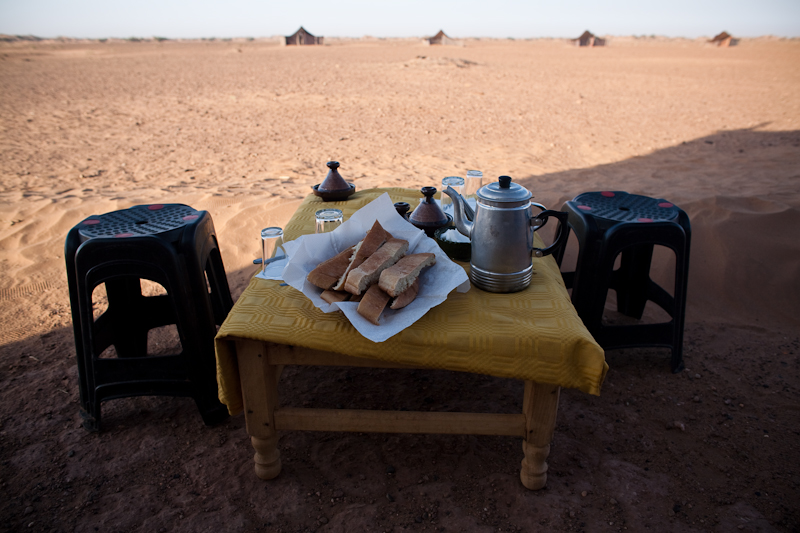
But here we are, in rel­at­ive luxury. For the moment we have shade, a large blanket to lay on and our sleep­ing mats to cushion the stones below. We have hot mint tea, cookies and peanuts. The tea is actu­ally good to drink in the heat; the body has less work to reg­u­late the tem­per­at­ure and process the liquid. We have enough mineral water left that we should be abel to get through to tomor­row without resort­ing to treated well water. We have a hot lunch on the way, and one more night in the Sahara to look forward to.

Tea, cookies, and salted peanuts. Our pre-lunch snack. I’ll never be a good enough writer to be able to convey how good this stuff tastes after four hours in the desert. That’s Laura’s fossil and lithics (stone tools) col­lec­tion in the background.

This is just one part of a six-part series on our camel trek in the Moroccoan Sahara. To read the full story, please click here.

This entry was posted in Morocco and tagged , , , , , , , , , , , , , , , , on by .